![Large Circular Yoga Mat Comparison: Nonslip Grip & Support[6][15]](/images/article/thumbnail/49cb1db8-f902-4a77-a8ea-e56ec2659117.avif)
Safe Yoga Mats for Kids: Balance, Grip and Fun Prints
By Mina Okafor • 29th Sep
What to do
Choose the floor setup before the fun print: measure the available space, decide whether a retailer-listed 3mm mat suits the child’s activities, and verify the material information your family requires. The Gaiam Kids Printed Yoga Mat may suit dry, gentle yoga, stretching, and calm floor play when its size, texture, and limited 6P-free claim fit your needs.
- Start with: Check the actual floor for bunching, edge lift, and movement, then confirm that a 60-by-24-inch mat fits with clear space around it.
- Then: Match the 3mm profile and light-tack surface to mostly dry, low-intensity use; do not treat them as proof of improved balance or grip performance.
- Important prerequisite: Read the PVC and six-phthalate claim narrowly. It does not establish broad chemical safety, PFAS- or VOC-free status, certification, or independent testing; seek product-specific documentation if that is essential.
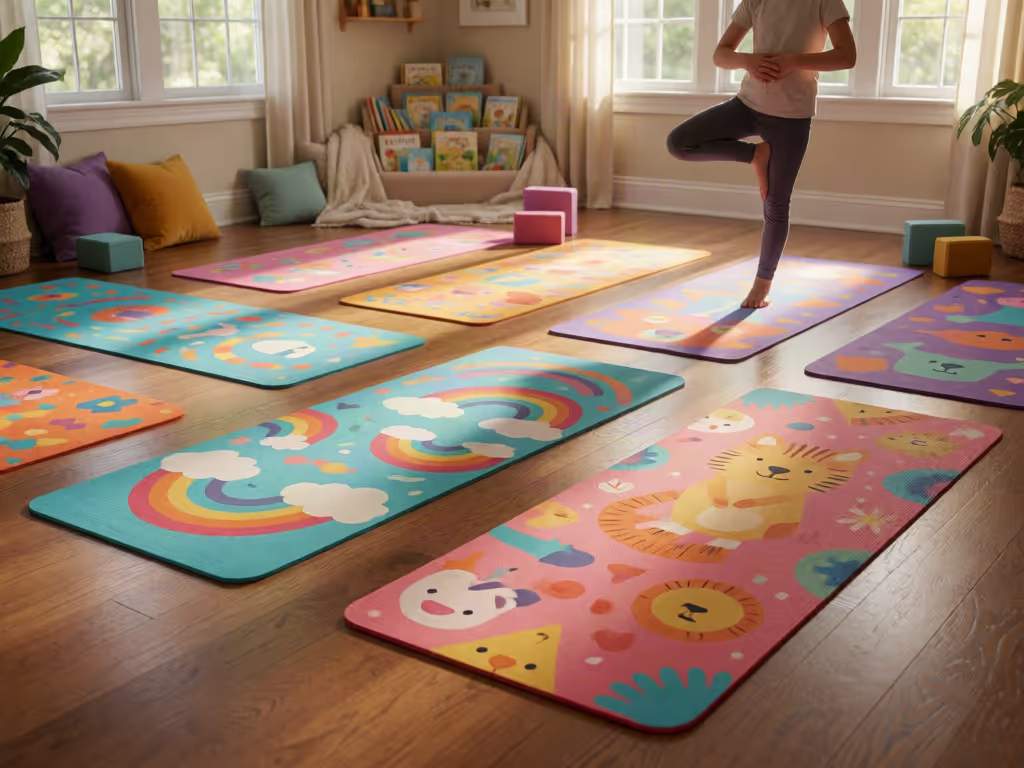
Choosing safe yoga mats for children can feel surprisingly high-stakes. You want a surface that invites play, stays reasonably steady beneath busy hands and feet, and gives you a clear materials story, not a vague promise on a package. The Gaiam Kids Printed Yoga Mat, 3mm is a child-oriented, printed PVC option listed for ages 5-8. It can be a practical starting point for gentle yoga, stretching, and floor play when its 3mm profile, light-tack texture, and material claim fit your home setup.
The key is to separate three decisions that are often rolled together: how the mat feels against the body, how it behaves on your floor, and what the material claim actually tells you. A cheerful print may make a mat more appealing, but it is the base, surface, and room setup that create a dependable practice space.
Comfort is engineered: density, thickness, and floor work together.
Step 1: Start with the floor, not the print
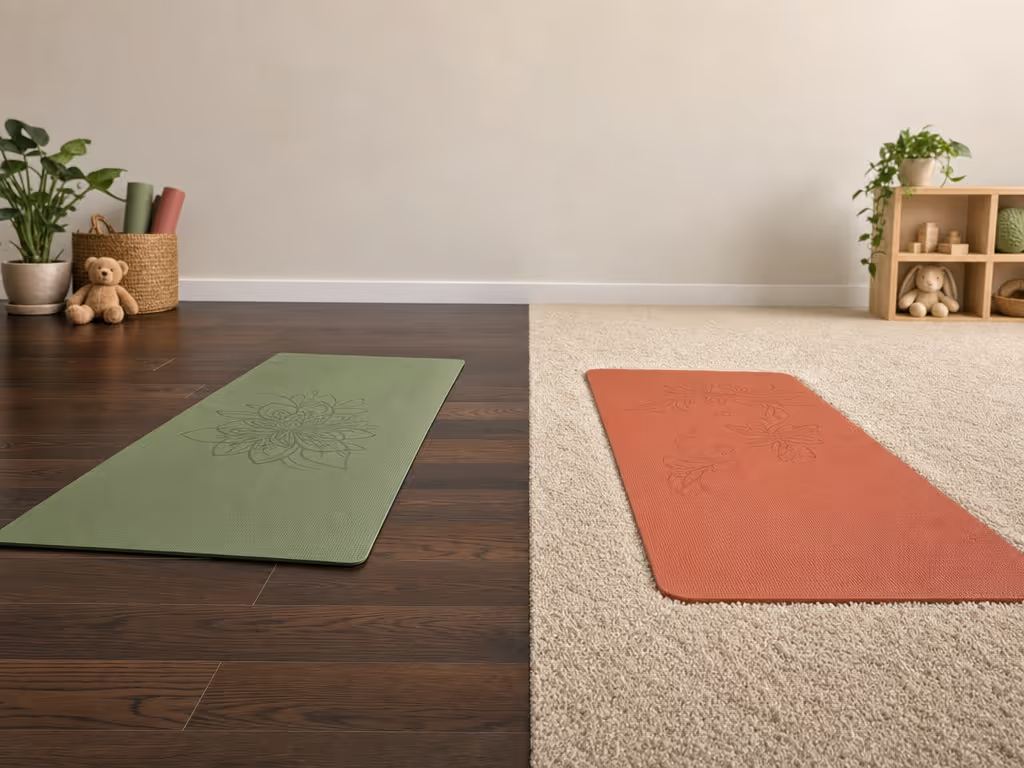
Before comparing any kids' yoga mat, identify where it will spend most of its time. The same 3mm mat can feel stable on one surface and less settled on another, so review this yoga mat floor compatibility guide before choosing its practice area.
Hard flooring: tile, hardwood, or laminate
Hard floors make a thin mat's role especially clear: it creates a defined practice zone and takes the edge off direct contact, but it does not turn a hard floor into a deeply cushioned one. Keep the area clear and lay the mat fully flat before use. If an edge curls or the mat shifts during a child's normal movement, pause and reset the setup rather than trying to work around it.
For quiet-time stretching or relaxed floor activities, a thin mat can be a tidy, low-profile choice. For activities with repeated impact or energetic jumping, consider whether a yoga mat is the right piece of equipment for that activity rather than expecting one surface to do every job.
Carpet
On carpet, inspect the mat before each session. A mat can look flat while the carpet beneath it compresses or moves. That softness may feel pleasant for kneeling, but it can also make standing positions feel less predictable. My first apartment's tile punished every lunge, and the plush mats I tried solved that immediate discomfort only by becoming wobbly during standing work. That experience is why I now prefer adjusting in layers rather than assuming thicker always means better.
The simple stability check
With the mat unrolled, have the child stand calmly near the center while you watch for obvious bunching, edge lift, or sliding. Then reassess after a few ordinary transitions. This is not a slip-resistance test; it is a practical home check of the specific floor-and-mat pairing in front of you.
Step 2: Decide what "safe" means for your family
"Safe" is a useful goal, but it is too broad to be a material specification by itself. A thoughtful purchase starts by turning it into answerable questions:
- Which material is the mat made from?
- Does the seller identify specific substances it says are excluded?
- Is there independent test documentation for the concerns most important to you?
- Will the texture and thickness work with the child's usual activity and floor?
For the Gaiam mat, the listing identifies the material as PVC and uses the promotional phrase "non-toxic." More specifically, it says the mat is 6P Free, meaning it is claimed to be free of six named phthalates: DEHP, DBP, BBP, DINP, DIDP, and DNOP.
That is more useful than an undefined blanket phrase, but it is still a limited claim. It does not establish that the mat is free of every phthalate or answer questions about PFAS, VOC emissions, dyes or inks, heavy metals, allergens, or other substances. No independent product-specific laboratory evidence for those areas is available here.
If chemical transparency is your deciding factor, ask the retailer or manufacturer for current, product-specific documentation before buying. If the available answers do not meet your household's needs, it is reasonable to pass rather than let a fun print make the decision for you.
A note on the phrase "non toxic yoga mat"
A non toxic yoga mat is not something a shopper can reliably identify from marketing language alone. Treat "non-toxic" as a starting prompt to look for precise disclosures, not as a complete safety conclusion. The Gaiam mat's 6P-free claim is narrower and clearer than its broad label, so use that specific claim when weighing it.
Step 3: Match cushioning to balance needs
The featured Gaiam mat is retailer-listed at 3mm thick, measuring 60 inches long by 24 inches wide. In general yoga mat thickness guidance, 3mm to 4mm sits in a moderate-cushion range: enough to create a distinct surface, without the pronounced softness of a thicker mat.
That matters because cushioning and steadiness are adjustable dials, not competing virtues. Extra softness can be welcome during floor contact, yet general mat guidance also notes that very soft or squishy surfaces can make standing balance more challenging. For a child's mixed practice (some standing, some seated, some quiet floor play), a flatter, firmer base is often the easier place to begin evaluating the setup.
Protect joints without losing balance by solving pressure-point comfort separately when needed. A folded blanket or a thin, removable topper can be introduced for brief, floor-based comfort, then put aside for standing activities. This approach is more controllable than choosing a deeply cushioned mat for every moment.
Do not interpret 3mm as a promise of joint relief, balance improvement, or developmental benefit. It is simply the listed thickness, and how it feels will depend on the child, the floor, and the type of movement.
Step 4: Review the Gaiam Kids Printed Yoga Mat, 3mm
The Gaiam Kids Printed Yoga Mat, 3mm is the clearest fit for families seeking a compact, child-size fun printed kids mat rather than an adult mat cut down to kid use. Gaiam's kids' 3mm line includes designs called Ballerina, Chomper, and Twinkle Toes; however, the exact print attached to a given retailer selection should be confirmed at checkout.
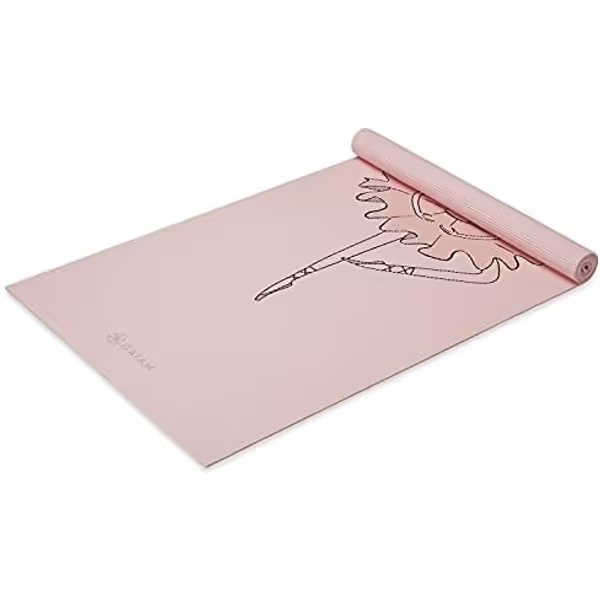
Gaiam Kids Printed Yoga Mat, 3mm
Fun, non-toxic mat for kids to learn yoga safely.
Thickness3mm
Thickness3mm
Pros
Non-toxic & 6P Free for safety
Textured, non-slip surface prevents falls
Includes bonus kids yoga class
Cons
Primarily for ages 5-8, limited age range
3mm thickness may lack cushion for some activities
What the listing supports
The product listing describes a textured, slightly sticky surface with light tack intended to provide grip. For a child who practices dry, low-intensity yoga or stretching, that texture may be the relevant feature, not a thick foam feel or a highly technical sweat-management surface.
It is also listed as intended for children ages 5-8 and includes a downloadable kids' yoga class. Consider the age range and class as manufacturer/retailer suitability features, not as independently validated developmental guidance.
The 60-by-24-inch footprint is worth measuring against your available space. A clearly bounded mat can make it easier to create a repeatable practice spot in a bedroom, living room, or classroom corner. Still, fit is personal: check whether the child can comfortably lie down within that length and whether the room leaves a clear margin around the mat.
What remains unverified
For an evidence-minded purchase, it is just as important to name what the listing does not establish:
- The texture claim is not independent wet- or dry-grip testing.
- There is no independent durability test for peeling, tearing, compression, or long-term grip.
- There is no product-specific evidence on odor, off-gassing, floor-side traction, or cleaning method.
- The PVC/6P-free description does not prove broad chemical safety or a particular certification standard.
- No evidence here shows that the mat itself improves balance, coordination, concentration, or movement participation.
This does not automatically make the mat unsuitable. It tells you where a sensible home trial and a few pre-purchase questions matter most.
Step 5: Use a five-minute arrival check
Once you have the mat, make the first session about setup rather than a long routine. Because no product-specific cleaning guidance is established here, follow the instructions supplied with your purchased mat and consult this guide to clean yoga mats without damage rather than assuming a cleaner, spray, or disinfectant is compatible.
1. Air it out and inspect it
Unroll the mat in the intended room. Look over the print, the surface, and the edges. If there is an odor or any condition that gives you pause, give it time and seek seller guidance before use.
2. Let it lie flat
Do not begin on a mat that is still curling noticeably from storage. A flat perimeter is part of a calm, predictable practice area.
3. Check the floor pairing
Place it where it will actually be used, not only on the kitchen floor if its real home is a carpeted bedroom. Observe whether the mat remains positioned during ordinary, supervised movement.
4. Keep the first activity dry and simple
The Gaiam listing describes light tack, but there is no independent evidence for performance under sweat or moisture. Start with dry hands and feet and reassess if the surface becomes damp. A mat that feels acceptable in a quiet, dry session should not be assumed to perform the same way in a humid room or vigorous activity.
5. Reassess comfort after use
Ask straightforward questions: Did the surface feel pleasant? Did the mat stay flat? Was there enough room? Did the child prefer more or less padding for floor time? These observations are more useful than trying to predict the perfect setup from thickness alone.
Step 6: Make the purchase decision with a short scorecard
The Gaiam is best considered when your priorities are a child-oriented size, a 3mm profile, and a playful printed look, and when the specific 6P-free PVC claim is acceptable for your household after you have considered its limits.
Use this scorecard before you commit:
| Question | A "yes" points toward this mat |
|---|---|
| Is the primary user within the listed 5-8 age range? | Yes |
| Do you want a 60 x 24-inch, 3mm mat rather than a heavily cushioned surface? | Yes |
| Will it be used mainly for dry, gentle yoga, stretching, or calm floor time? | Yes |
| Have you checked that the print and seller details are correct for the option you are buying? | Yes |
| Is a seller claim of PVC and 6P-free coverage of six named phthalates sufficient for your material-screening process? | Yes |
| Are you comfortable testing its real-world stability on your own floor? | Yes |
If the answer to the material question is "not yet," pause there. A product can be appealing in every other way and still fall short of the documentation your family wants.
FAQ
What is the safest material for yoga mats?
There is no universally "safest" material conclusion supported by the information available for this product. Material names and broad labels do not replace product-specific disclosure or testing. The Gaiam mat is listed as PVC and claimed to be 6P-free for six named phthalates; that limited claim should not be read as proof of complete non-toxicity.
Are Gaiam yoga mats non-toxic?
It would be too broad to describe all Gaiam yoga mats that way. For this specific kids' mat, the retailer listing uses "non-toxic" and makes a more specific 6P-free claim. There is no independent product-specific testing here to verify a wider non-toxic claim.
The practical next step
For a child's first mat, choose the floor setup before the print: measure a clear 60-by-24-inch space, decide whether 3mm is enough cushion for the intended activity, and make a materials checklist with the exact answers you need. If the Gaiam Kids Printed Yoga Mat meets that checklist, confirm the selected print and current seller details, then use the five-minute arrival check on the actual floor where it will live.
A playful mat should make the space feel inviting. For broader guidance on child-safe yoga mats, including sizing and non-toxic material considerations, compare this setup with the needs covered in our dedicated kids' mat guide. A well-matched base is what makes it feel dependable.
Related Articles