
Designing 360° Flows on a Large Yoga Mat at Home
By Jonah Park • 17th Sep
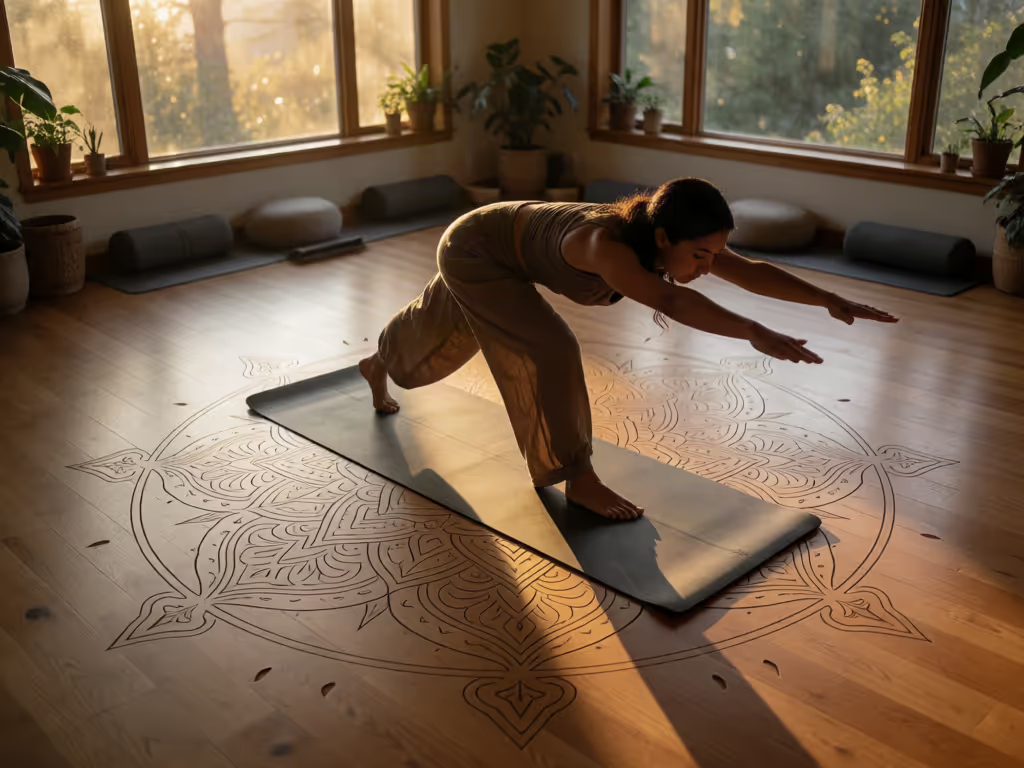
At a glance
The strongest design is not the roundest or largest mat: it is a clear, repeatable flow that changes orientation deliberately and returns to its starting direction.
- 1. Best overall approach: Build the sequence in quarters: establish one direction, introduce a single controlled turn, work from the new orientation, then repeat the other side to return.
- 2. Best practical cueing system: Assign the perimeter clock-face landmarks such as 12, 3, 6, and 9 o’clock.
- 3. What decides it: Controlled transitions matter more than mat shape or thickness. Use a wall or sturdy chair if balance is difficult, and stop, rest, or modify for pain, significant dizziness, or unusual discomfort.
Important: No collected comparative evidence shows that round-mat or multi-directional practice improves balance, spatial awareness, engagement, or injury outcomes, and one 53-inch product specification cannot define what “large” means.
This guide focuses on designing a home mandala-style flow that changes orientation around the mat. Yoga Journal describes mandala flows as movement in various directions all around the mat. The mat is simply the stage. Before choosing that stage, compare your body dimensions with the mat's usable length and width in this guide to matching a yoga mat to your body size. Pay for performance, not polish, and build the movement logic before you let an unusual shape dictate the practice.
1. Define the job: orientation change, not novelty
A mandala-style practice is described by Yoga Journal as movement in various directions all around the mat. That is the useful starting point. Your goal is not to spin constantly or use every inch of the surface. It is to create a flow with a clear departure, a controlled turn, and a return.
Use this hard filter before designing anything:
- Keep a turn if you can name where you begin and where you will land.
- Keep a transition if you can do it slowly without losing the thread of the sequence.
- Cut a transition that exists only to prove the mat is round or oversized.
The published example uses rectangular-mat landmarks, including the back of the mat, a long side, and an outer edge. No collected source explains how to translate those landmarks to reliable round-mat cues. Treat the circle as a creative constraint, not a performance upgrade.
2. Give the mat landmarks before you start moving
Yoga Journal's published example uses cues such as facing the back of the mat, facing a long side, and placing the leg along the outer edge. The source does not explain how to translate those rectangular-mat landmarks to a round surface, so choose a reference system before you begin.
Here is a simple design suggestion: assign one point on the perimeter as 12 o'clock. Then use 3, 6, and 9 o'clock as your other major waypoints. You do not need markings on the mat; a consistent mental map is enough.
For a self-guided practice, make every cue answer one of three questions:
- Where am I facing? For example: 'Turn toward 3 o'clock.'
- Where do I place myself? For example: 'Set up near the middle rather than at the rim.'
- What changes next? For example: 'Pause, then turn toward 6 o'clock.'
This is especially useful if you switch between a standard rectangle, a square surface, and a meditation mat. The landmarks live in your plan, not in the product shape. If you are comparing yoga mats with alignment guides, keep the clock-face plan consistent across mat shapes.
3. Build the flow in quarters, not in a blur
For the type of orientation-changing home flow described here, use four parts. Think in quarters of a circle rather than trying to choreograph a seamless full rotation from minute one.
Quarter A: establish your starting orientation
Begin with familiar, lower-complexity shapes. Yoga Journal's published mandala-flow example starts with Tabletop, Cat Pose, Puppy Pose, and Thread the Needle. That is a sensible structural lesson: begin where you can establish breath, hand placement, and direction without a rushed pivot.
Quarter B: introduce one deliberate turn
Choose one point where the chest and gaze clearly reorient. In the published example, a transition moves from Kneeling Side Plank to Head-to-Knee Pose, with the chest turning toward the back of the mat. The important design feature is not those exact poses; it is the unmistakable change in facing direction.
Quarter C: work from the new 'front'
Once you turn, stop treating the original direction as primary. Do a small, coherent cluster from the new orientation. A flow gets confusing when each pose has a different imaginary front.
Quarter D: make the return intentional
Complete the other side of your sequence so that you arrive back at your original orientation. In the Yoga Journal example, repeating on the other side makes the way back to the front of the mat. That symmetry is useful because it gives the practice an endpoint rather than an arbitrary final turn.
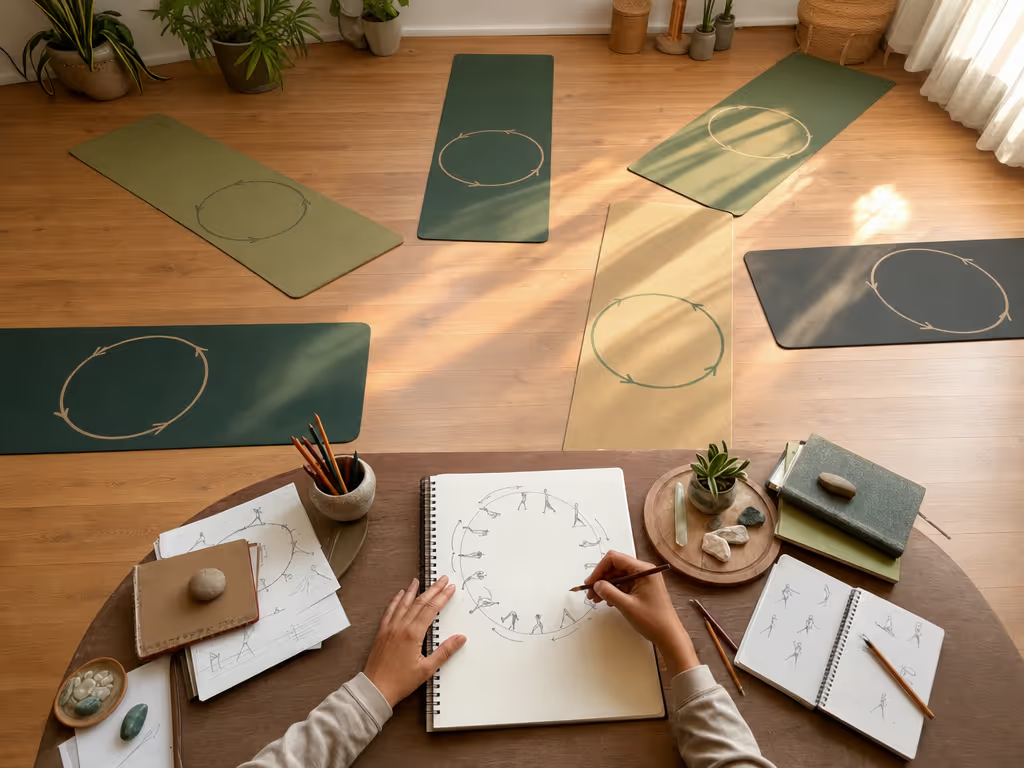
4. Limit instructions so the turn does not become the workout
Multi-directional movement can frustrate or confuse some practitioners. Sage Rountree's teaching approach recommends no more than three instructions on the first side of a pose, then using the second side to refine the experience once the setup is understood.
For home practice, apply that as a restraint rule:
- First side: name the orientation, the base position, and the next move.
- Second side: repeat the structure with less internal chatter.
- Longer holds: choose either silence or a brief, purposeful check-in rather than stacking corrections.
For example, 'Face 3 o'clock. Settle into the shape. On your next transition, turn toward 6 o'clock.' That is enough information to preserve the map. If your plan needs a paragraph of directions to get through one turn, simplify the plan. For more detail on preventing slips during rapid pose changes, see this analysis of mat performance during dynamic transitions.
A good circular yoga sequence feels legible while you are in it, not merely clever on paper.
5. Treat the perimeter as a boundary, not a target
Do not treat a larger surface as a requirement to use its outer rim. Keep your base positions repeatable. When you turn, favor a clear reset over an improvised scramble across the perimeter.
This also avoids a common mental trap: assuming a thin yoga mat or a thick one determines whether an orientation-changing practice works; a full yoga mat thickness trade-off guide can help you evaluate comfort and stability separately. The available evidence does not establish an ideal thickness for this type of practice. Thickness is not a substitute for clear orientation and controlled transitions.
One specific round-mat example illustrates why product specifications must stay product-specific: Scoria lists its Essential Round Cork Yoga Mat as a 53-inch circle with 4.5 mm thickness, and identifies natural rubber latex as a possible allergen. That does not define 'large,' establish the biggest mat available, or make that size or thickness right for you. It is a single manufacturer specification, nothing more.
6. Slow down at the points where direction changes
The turn is the part worth respecting. The Yoga Institute's balance guidance suggests a conservative sequence: place the feet, find the posture, breathe, focus, and then gradually move. Use that as your transition checklist whenever your orientation changes.
Do not turn the checklist into a rigid ritual. Use it to interrupt momentum when momentum has become sloppy.
If balance feels difficult, its guidance also suggests using a wall or sturdy chair for support. And if a pose brings pain, significant dizziness, or unusual discomfort, stop, rest, and modify. People with a history of falls, significant dizziness, neurological conditions, joint problems, or other medical concerns should seek appropriate professional guidance before challenging balance work.
That is not an argument against flowing. It is an argument against treating fast pivots as a test of commitment. A mat cannot compensate for a transition you cannot control.
7. Run a one-round test before you repeat the flow
Before committing to several rounds, practice the sequence once at a reduced pace. Your test is not aesthetic. It is operational:
- Did you know your orientation at every transition?
- Could you repeat the same path on the second side?
- Did any location cue become meaningless once you turned?
- Did the final position return you to your chosen starting direction?
- Did you need more than three instructions to remember a single phase?
If the answer is no, remove a turn or shorten a pose cluster. The most durable design is usually the one with fewer failure points. An orientation-changing flow need not be complicated to feel complete.
FAQ: What is one example of a mandala-style sequence?
One published example begins with Tabletop, Cat Pose, Puppy Pose, and Thread the Needle. It later includes a turn from Kneeling Side Plank to Head-to-Knee Pose, then uses orientation cues in standing and lunge positions before repeating the other side to return to the starting direction. Use it as an example of structure, not as a required formula.
FAQ: What is the biggest size yoga mat available?
There is no supported answer here. One manufacturer lists a 53-inch circular model, but that single listing does not establish the largest yoga mat on the market.
Summary and final verdict
For the orientation-changing home flow described in this guide, work around one clear orientation change at a time: establish a starting direction, choose a turn, practice from the new direction, and complete the other side to return. Create your own clock-face landmarks if your large yoga mat does not provide rectangular edges, and strip the cues down until each phase is easy to execute.
The final verdict: a round mat is not established as safer or superior for this orientation-changing flow. This type of flow succeeds when the sequence is intelligible and the transitions are controlled. Pay for performance, not polish, and let the mat support the practice rather than become the practice.
Related Articles