Mini Yoga Pads for Non Slip Handstands and Inversions
By Jonah Park • 25th Sep
At a glance
The YOGA Premium PU Mini Yoga Mat is a compact mini mat marketed by the retailer for handstands and inversions, not a proven non-slip handstand solution.
- Best overall: Choose it only if you specifically want a small mat the retailer markets for handstands, inversions, Pilates, meditation, or use over a shared mat. View on Amazon
- Best for cautious testing: There is no independent confirmation of dry or sweaty-wet traction for this mat. The retailer’s sweaty-wet grip claim is not independently confirmed.
- What decides it: Pass if you need documented wet traction, verified durability, or confirmed latex-free status. Natural-rubber labeling may matter for latex allergies, but this product’s exact allergen status is unknown.
Important: This pad does not guarantee against slipping, falling, or wrist injury; active hand engagement and sensible progression still matter.
A yoga pad can be a useful addition to an inversion setup, but the phrase "non slip" is doing far too much work in most product listings. For a mini yoga mat marketed for inversions, the hard requirements are modest but unforgiving: dimensions that suit your setup, a stable base over your existing mat or floor, and surface behavior you can trust only after you test it under your own dry and sweaty conditions. This guide evaluates the available evidence on the YOGA Premium PU Mini Yoga Mat rather than treating anti-slip marketing as proof.
That distinction matters. The retailer presents this compact pad as portable and markets it for handstand practice, but the available evidence does not establish its grip under real practice conditions or its effect on wrist loading. Value is verified, not assumed from a product title.
1. Start with the correct job: a compact mini mat
The YOGA Premium PU Mini Yoga Mat is listed at 24 × 15.7 inches (60 × 40 cm), 4 mm thick, and approximately 1.21 pounds / 550 g. Those numbers immediately define its compact size.
The retailer markets it for handstands and inversions, but the listing does not prescribe whether palms, forearms, knees, or elbows should be placed on it.
That is useful in several situations:
- You practice kick-ups, handstand drills, or arm balances on a larger mat and want to test a compact accessory in that setup.
- You use borrowed studio, hotel, or gym mats and prefer your own small contact surface. The retailer specifically presents this as a pad that can sit atop another mat.
- The retailer describes it as a portable small yoga mat.
- You want a small pad that the retailer markets for meditation.
It is a poor match if you need more coverage than its listed 24 × 15.7-inch footprint provides, or expect it to stay put on every bare floor without testing. There is no hands-on testing available that establishes its floor-side traction, including on tile, hardwood, carpet, or another mat.
2. The product’s measurable case is its dimensions, thickness, and weight
The YOGA Premium PU Mini Yoga Mat has a documented specification: 4 mm thickness, a 24 × 15.7-inch footprint, and approximate 1.21-pound weight. It is listed for Pilates, handstands, inversions, and meditation.
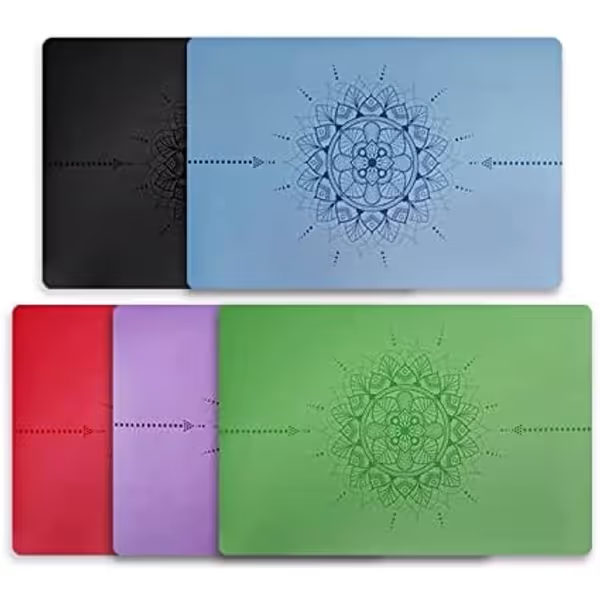
YOGA Premium PU Mini Yoga Mat
Grip-on-demand mini mat for sweaty hands, feet, and joint support.
MaterialNatural Rubber & PU
MaterialNatural Rubber & PU
Pros
Superior non-slip grip, even when sweaty
Portable and lightweight for travel or studio use
4mm cushion protects joints with alignment lines
Multi-functional for various practices or personal hygiene
Cons
Small size (15.7"x24") limits full body practice
May not provide enough cushion for some users
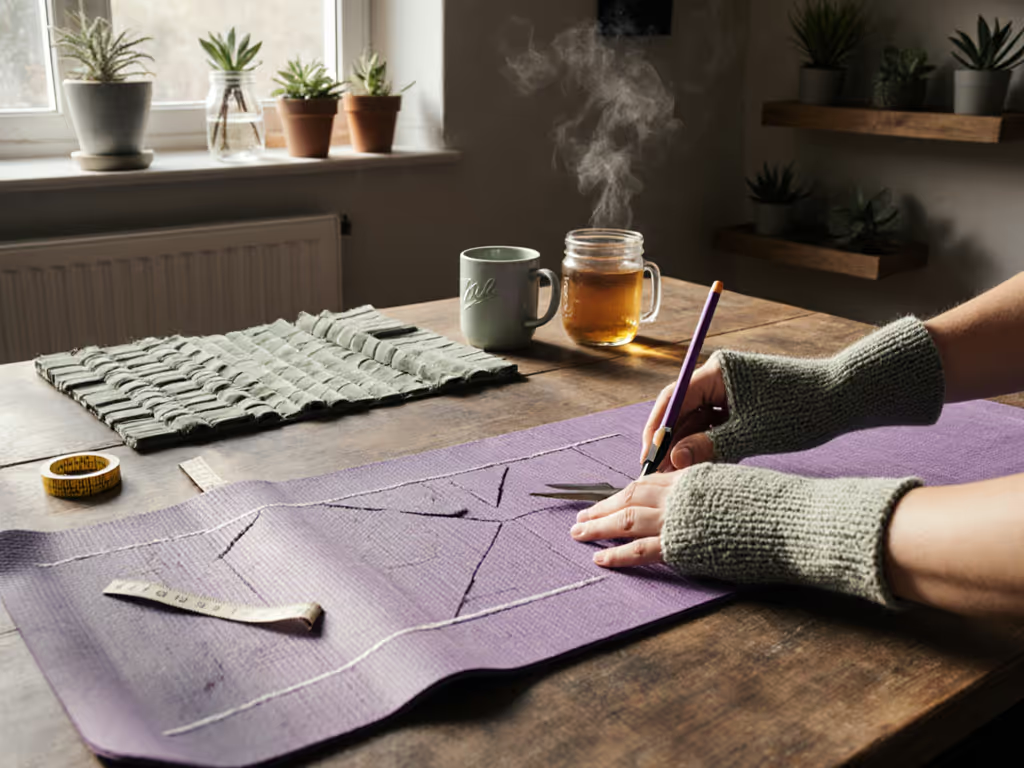
The dimensions are the strongest evidence here because they are concrete. Before buying, use painter’s tape or a towel to mark out a 24 × 15.7-inch rectangle where you normally practice. Place your hands at the width you use for downward dog, crow, wall drills, and kick-ups. Then answer two practical questions:
- Do both palms fit without crowding the edges?
- Can you reset between attempts without repeatedly stepping off or moving around the pad?
If the answer to either is no, the small footprint will become friction in the workflow, regardless of surface material or price. Inverted practice is repetitive. Equipment that forces constant repositioning rarely earns a long-term place in a dialed-in setup.
The 4 mm thickness is a specification, not proof of comfort. Category-level guidance characterizes natural rubber as dense and firm and says thinner rubber can provide more support than thicker air-filled foam. But the listed thickness alone does not establish exactly how this pad will feel under your wrists.
3. Treat "sweaty-wet grip" as a claim to test, not a safety feature
The retailer says the pad remains grippy even when "Sweaty-Wet". That could be attractive to hot-yoga practitioners and anyone whose palms get damp during repeated wall drills. But there is no independent wet-grip test for this particular mat.
There is a reason to be skeptical: category-level manufacturer guidance for natural-rubber yoga mats notes that moisture can sit on the surface and become slippery for heavy sweaters. That does not prove this yoga pad will become slick. It simply means the listing's claim has not resolved the real question: what happens to this exact surface after sweat accumulates under loaded hands?
For inversions, "grippy" is not a label. It is a behavior you verify during controlled practice.
Use this simple first-week test before relying on it for unassisted attempts:
- Dry check: Put the pad on the surface and setup you will actually use. Press through open hands and shift gently forward, back, and side to side.
- Damp-palm check: With lightly damp hands (not a soaked surface) repeat slow weight shifts and downward-dog-style loading.
- Edge check: Notice whether the corners lift, curl, or move as you step near them and reset.
- Stop rule: If your hands slide or the pad migrates, do not escalate to kick-ups or freestanding work on that setup.
These checks do not guarantee against slipping, falling, or wrist injury.
4. Material labeling leaves a major unanswered question: allergy suitability
The retailer title describes the item as both a "Premium PU" mini mat and a natural-rubber mat. No manufacturer documentation was available to clarify the layer construction, determine the exact composition, or confirm whether latex proteins are present.
That ambiguity matters for anyone with latex sensitivity. Natural rubber can contain proteins that trigger latex allergies. Since the exact allergen status of this pad is unconfirmed, do not treat it as latex-free or allergy-safe.
For shoppers without that concern, the labeling still leaves questions about long-term use. PU-like top layers and rubber bases can be designed to serve different functions, but no independent longevity evidence establishes how this product will hold up over time. Odor is also unverified.
The limitation here is simple: this product has no collected independent longevity evidence and no published manufacturer warranty terms in the available information. Buy it for its stated compact form factor, not on an assumed multi-year durability story.
5. The care routine should be conservative until product-specific instructions exist
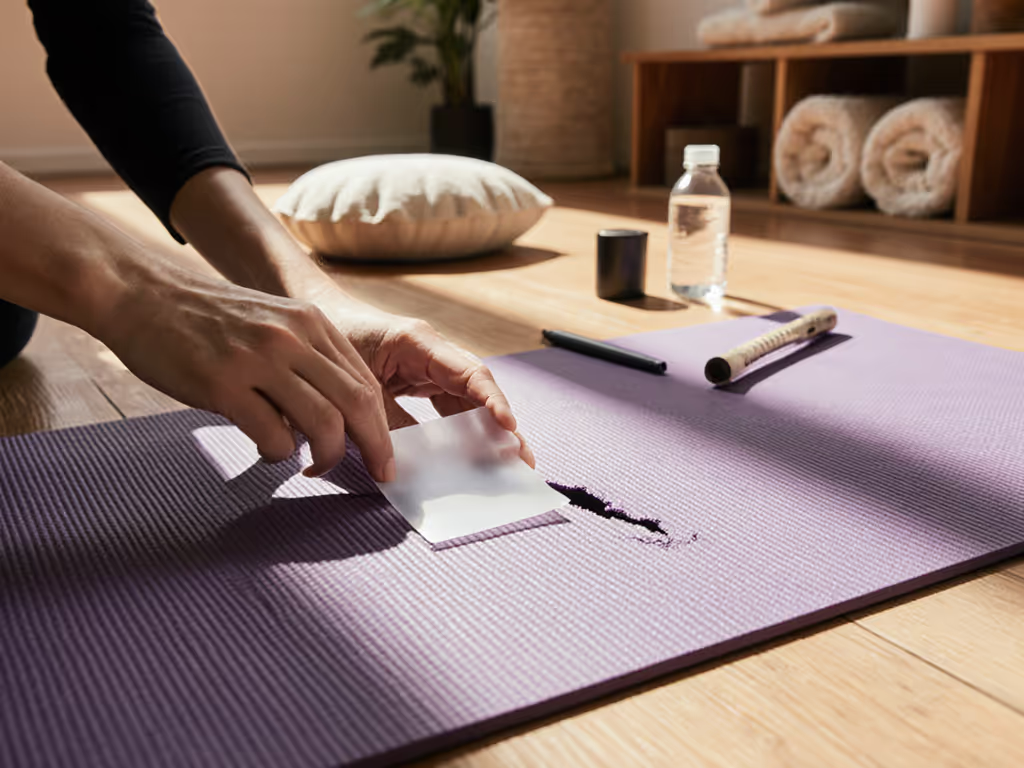
No product-specific manual or official care instructions were available. The safest useful reference is category-level care guidance for natural-rubber yoga mats: avoid heavy soaps and alcohol-based cleaners, and let the mat air-dry completely before rolling it up.
Because the YOGA pad's exact construction is not confirmed, do not assume every cleaner marketed for yoga equipment is compatible with it. Until product-specific instructions exist, follow the category-level guidance rather than assuming other cleaners are suitable.
A cautious routine is straightforward:
- Wipe only as needed with a soft, damp cloth.
- Avoid heavy soaps and alcohol-based cleaners unless product-specific instructions say otherwise.
- Air-dry fully before rolling or storing.
- Do not leave it damp inside a gym bag or tightly rolled after a sweaty session.
- Inspect the top surface and edges regularly for changes in texture, separation, or curling.
If hygiene is the central reason for carrying a pad, remember its retailer-stated use case: it can be placed over a borrowed mat.
6. This product’s thickness does not establish wrist protection
The listed 4 mm thickness does not establish that this pad protects wrists or prevents injury. No clinical or product-specific evidence supports that use.
For handstands and arm balances, active hand engagement remains the more controllable variable. General yoga teaching guidance recommends spreading the fingers, pressing through the knuckles, and actively engaging the hands rather than sinking passively into the palm. If wrist discomfort occurs, progressive practice, warm-up, and modification are more defensible responses than simply stacking more padding.
The practical filter is simple: for this product, do not infer wrist protection from the listed 4 mm thickness. If wrist discomfort occurs, follow progressive warm-up and modification guidance rather than assuming more padding will solve it.
For weight-bearing yoga and handstand practice, prioritize active hand engagement and use progressive modifications and strength-building when needed.
7. Who should buy this mini yoga mat - and who should pass
Buy it if your needs match the documented specifications
The YOGA Premium PU Mini Yoga Mat is a reasonable candidate if you want:
- A compact yoga pad with a listed 24 × 15.7-inch footprint.
- A 4 mm pad rather than a thick foam cushion.
- An approximately 1.21-pound accessory.
- A retailer-marketed option for handstands, inversions, Pilates, meditation, or use over a shared mat.
- A product you are willing to evaluate cautiously in your own dry and damp conditions before relying on it.
Pass if you need proof in any of these areas
Skip it, or wait for clearer manufacturer documentation, if you require:
- Confirmed wet-grip performance for hot yoga or very sweaty hands.
- Verified floor grip on tile, hardwood, carpet, or layered mat setups.
- A confirmed latex-free or allergy-safe material declaration.
- Published warranty coverage, exact layer construction, or verified durability testing.
- More coverage than its listed 24 × 15.7-inch footprint.
- Anti-slip performance you can rely on as a guarantee against slipping, falling, or wrist injury.
This is not a judgment against the pad. It is plain pricing math without a price: if the key performance requirement is unverified, its value to you is also unverified.
8. FAQ: rubber versus foam, and yoga use versus exercise use
Is a rubber or foam yoga mat better?
Neither wins outright. Category-level manufacturer guidance describes natural rubber as dense and firm and says thinner rubber can provide more support than thicker air-filled foam, while emphasizing that material choice depends on your priorities. For sweaty practice, do not assume rubber is automatically reliable: moisture can make some rubber surfaces slick, and this specific pad has not been independently wet-tested.
Can a yoga mat be used as an exercise mat?
Sometimes, but not universally. A separate cork-and-rubber mini pad is marketed for yoga, mobility work, and bodyweight training, showing that some compact mats are positioned for multiple activities. Whether any particular yoga mat works for exercise depends on its size, thickness, surface behavior, and how it stays put in your intended movements. For this YOGA pad, the retailer lists Pilates and inversion-related uses, but independent performance validation is unavailable.
9. Final verdict: a practical compact format, with performance still to prove
The YOGA Premium PU Mini Yoga Mat clears the first size filter for a compact mat: it has a listed 24 × 15.7-inch footprint, 4 mm thickness, and approximate 1.21-pound weight. Its retailer also positions it for handstands, inversions, and use over shared mats.
But do not confuse plausibility with proof. Its wet grip, dry traction, floor stability, odor, long-term wear, and exact PU/rubber construction remain unverified. The retailer's sweaty-wet grip claim is worth testing, not relying on sight unseen, particularly if your practice includes hot rooms, humid climates, or repeated kick-ups.
Final verdict: Consider it if you specifically want a compact, 4 mm mini mat that the retailer markets for handstands and inversions, and you can test it conservatively on your real setup. Pass if you need documented wet traction, allergy confirmation, or durability evidence before you buy. A popular yoga mat is not necessarily a dependable one; the right yoga pad is the one that remains stable, intact, and predictable after the novelty wears off.
Related Articles