Best Folding Travel Yoga Mat: Fold vs Roll for Lasting Grip
By Aiko Tanaka • 6th Sep
Quick verdict
As of September 2026, Manduka described its travel collection as lightweight, foldable, and designed for travel. Those models can be a practical choice when luggage space matters, but the evidence does not show that folding or rolling universally preserves grip better.
- Choose folding if: Your mat is explicitly designed to fold and suitcase space is the main constraint.
- Choose rolling if: Your mat’s instructions support rolling or you are carrying it between home and class. Rolling is not proven safer for grip, and it should only happen after the mat is completely dry.
- Main trade-off: Portability depends on material, thickness, and surface texture—not a universal fold-versus-roll rule.
Important: No collected study compares folding and rolling the same mat over time for creasing, surface wear, or measured grip retention. Follow the care instructions for your exact material, especially for natural rubber and polyurethane surfaces.
If you are searching for the best folding travel yoga mat, begin with a more useful question than "fold or roll?": Was this specific mat designed to fold, and can you keep its surface clean and completely dry between practices? In the fold vs roll yoga mat decision, the available evidence does not show that one packing method universally preserves grip better than the other. It does show that, as of September 2026, Manduka described its travel collection as lightweight, foldable, and designed for travel—and that material-specific care, full drying, and dry storage matter to usable life.
For commuters and travelers, this is good news. For a closer look at lightweight options that balance packability with traction, see our travel yoga mats that grip guide. You do not need to fear every fold line. You do need a repeatable packing routine that protects the conditions your hands and feet actually feel. Field heat is the truth serum for mat grip: the useful choice is the one that stays manageable once the room is warm, the floor is busy, and your mat is no longer pristine.
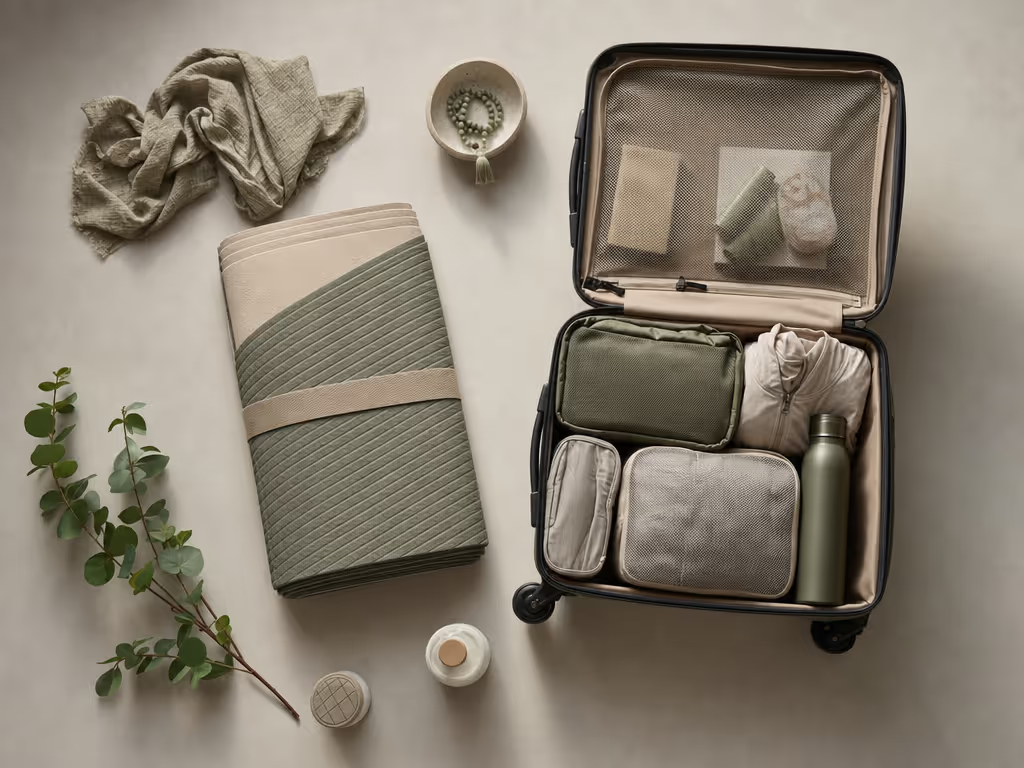
Step 1: Separate "foldable" from "a mat I happen to fold"
This is the first and most important filter. A travel mat advertised by its maker as foldable is the appropriate candidate for suitcase packing. That does not mean every yoga mat (especially a thicker or differently constructed one) should be folded the same way.
As of September 2026, Manduka described its travel collection as lightweight, foldable, and designed for travel. At that time, the collection included the Manduka eKO Travel Superlite Yoga Mat 1.5mm, described as an ultra-thin natural-rubber mat designed to fold down small with textured grip; the Manduka GRP Adapt Travel Yoga Mat 1.5mm, described as thin, foldable, and easy to pack with a moisture-absorbent surface intended for wet and dry grip; and the Manduka PRO Travel Yoga Mat 2mm, described as a foldable-format mat with high-density cushioning and floor-like stability.
Those are useful examples of a category, not proof of a universal winner. No collected source directly compares folding and rolling an otherwise identical mat for long-term grip retention.
Your check: Read your own mat's product description and care instructions before packing. If it is not described as foldable, do not assume that folding is its recommended storage method.
Step 2: Choose fold or roll based on the trip, not a crease theory
A folded mat can make sense when suitcase space is the constraint. A rolled mat can make sense when you are carrying it from home to studio. But the practical choice should follow the mat's intended format and your bag shape, not an unsupported claim that folds automatically destroy grip or that rolling is always safer.
Use this simple decision sequence:
- Confirm the mat is made to fold. If yes, folding for travel is within its stated use case.
- Pack only when the mat is fully dry. This matters whether you fold or roll.
- Use the configuration your luggage can close around without forcing the mat into an awkward position. The evidence does not establish one tested, material-neutral suitcase sequence, so avoid presenting any particular fold pattern as protective science.
- Unpack promptly at your destination. Lay the mat flat before practice and inspect the practice surface.
The last point is a real-world safety check, not a promise about durability. Run your palm across the top: you are looking for a clean, dry, even-feeling surface. Then test it where it counts (downward dog, a lunge transition, and a slow twist) before moving quickly.
A compact mat earns its place only when portability does not make you negotiate with your footing.
Step 3: Treat dry-down as part of your travel plan
Packing a yoga mat in a suitcase starts after dry-down, not when class ends. Manufacturer guidance recommends allowing a mat to dry completely before rolling it up and storing it in a cool, dry place; do not roll it while even slightly damp. Independent guidance similarly notes that cleaning and storage can affect how long a mat remains usable, with full drying before storage. For material-specific cleaning methods and storage tips, consult our natural rubber mat cleaner guide.
In a hot or crowded class, that delay is the inconvenient part. I learned to budget for it after an August class where the AC gave up, the room fogged, and a light travel mat became unreliable during a straightforward twist. The heavier backup held through the puddles, but the lesson was not "buy heavy." It was to stop treating post-class care as optional when sweat is part of the practice.
A repeatable dry-down routine
- Clean according to the material and the mat's instructions. Unsuitable cleaners can leave a slippery surface or contribute to premature material breakdown.
- Leave the mat open until it is completely dry. Do not let suitcase timing rush this step.
- Check the mat before packing.
- Store it dry and cool once home or at your hotel. A closed suitcase is transport, not a drying rack. Once you reach your destination, these yoga mat storage solutions can help prevent creasing, warping, and material degradation.
Studio chaos, simple choices: clean it appropriately, dry it fully, then pack it.
Step 4: Match grip expectations to surface and sweat conditions
"Lasting grip" is not one property with one cause. Yoga-mat performance varies with material, thickness, and surface texture. Wirecutter evaluated stickiness and texture in both dry and moist conditions among its tested mats. Our guide to yoga mat surface textures explains smooth, raised, and patterned finishes. This is why it is worth testing your own mat in the conditions where you practice.
For travel selection, write down the condition you most need the mat to handle:
- Mostly dry practice: Prioritize the surface feel and traction you can verify with clean, dry hands and feet.
- Frequent sweaty practice: In its September 2026 description, Manduka said the GRP Adapt Travel Yoga Mat 1.5mm had a moisture-absorbent surface intended to provide grip in wet and dry conditions. That is a manufacturer claim, so test the mat in your own class conditions before relying on it in faster transitions.
- Layered practice: If you usually practice over another surface, test that exact setup before traveling.
The right safety-forward standard is modest: a few deliberate checks under your normal conditions, rather than a conclusion drawn from how tidy the mat looks fresh out of the suitcase.
Step 5: Use material-specific care, especially for surface grip
Care errors can matter more than whether your travel mat is folded or rolled. Cleaning guidance varies by material, including rubber, PVC, cork, TPE, polyurethane (PU), microfiber, and jute. Follow the care label or the manufacturer's instructions for the exact mat in your hands.
A few boundaries are worth keeping clear:
- PU surfaces: Manufacturer guidance notes that oils can clog pores, potentially causing permanent staining or loss of stick. Avoid improvising with oily cleaning products.
- Natural rubber: Manufacturer guidance warns that direct sunlight can degrade natural rubber and reduce grip. Do not leave a natural-rubber mat baking by a window, in a car, or outdoors when it is not in use.
- PVC yoga mat material: Do not borrow cleaning rules from rubber, PU, or cork simply because the mat looks similar. Material-specific instructions are the safer choice.
This is also where odor and texture changes deserve attention. If a cleaner leaves the top feeling slick, stop using that cleaner and return to the mat maker's care directions. If the surface is no longer dependable in your basic pre-practice checks, adjust your setup rather than forcing fast flow on uncertain traction.
Step 6: Set realistic expectations for thin travel formats
Travel mats often make a clear trade: less bulk for easier packing. In Manduka's September 2026 travel collection, the eKO Travel Superlite and GRP Adapt Travel models were 1.5 mm thick, while the PRO Travel model was 2 mm thick. Those figures are examples, not a universal travel-mat standard or a prescription for every body and practice.
Thickness is one factor in yoga-mat performance, alongside material and texture. For a deeper breakdown of cushioning, stability, and portability considerations, read our yoga mat thickness guide. Manduka's September 2026 description called the GRP Adapt Travel thin, foldable, and easy to pack; before a trip, practice on your own mat at home for at least one normal session. Notice kneeling positions, transitions, standing balance, and whether the floor-side traction feels settled on the floor you will use most often.
Do not ask a travel mat to solve every use case. A compact mat that packs cleanly and gives you a trustworthy practice surface on the road can coexist with a more substantial mat at home.
FAQ: Folding travel mats, quickly answered
Are foldable yoga mats any good?
They can be a sensible travel option when the maker specifically supports folding. As of September 2026, Manduka described named travel models as foldable, with model-specific claims covering textured natural-rubber grip, moisture-absorbent wet and dry grip, and high-density cushioning with floor-like stability. What is not established is whether folding or rolling the same mat delivers better long-term grip retention.
Which type of yoga mat is better?
The available evidence does not identify one universally better type. It shows that material, thickness, and surface texture affect performance. Wirecutter evaluated its tested mats for stickiness and texture in dry and moist conditions. Start with your sweatiest realistic class, your usual floor, and the amount of cushioning you need, not a universal label.
What thickness is best for a travel mat?
The available evidence does not establish one best travel-mat thickness. Manduka's September 2026 travel collection included 1.5 mm eKO Travel Superlite and GRP Adapt Travel models and a 2 mm PRO Travel model. These are manufacturer-specific examples rather than a universal standard. Test a thin mat in your own kneeling, balance, and transition work before making it your only mat.
Your next step: run a one-trip packing test
Before your next flight or long commute, clean your mat with the appropriate method, let it dry fully, then pack it in the way its maker supports. At your destination (or at home as a rehearsal) unpack it, lay it flat, and perform three controlled checks: downward dog, lunge transition, and a slow twist.
If the surface feels clean, dry, and dependable in the hardest condition you expect to face, you have made the travel choice that matters. Fold or roll is secondary to that.
Related Articles