Wheelchair Yoga Mat Comparison: Stability & Grip
By Sofia Álvarez • 12th Apr
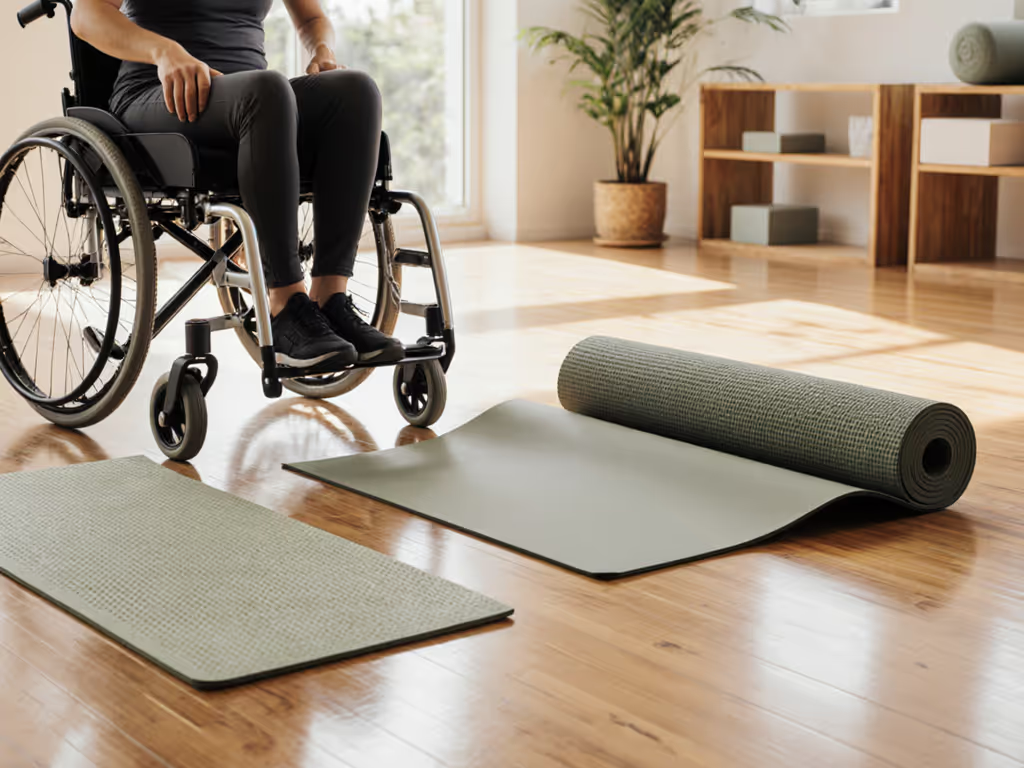
When you practice yoga from a wheelchair, your mat is not just a floor covering, it's a foundation for safety, alignment, and the ability to stay grounded while your body moves. The difference between a standard yoga mat and one engineered for seated or wheelchair-based practice can mean the difference between a confident, restorative flow and a session interrupted by slipping hands, shifting hips, or the constant micro-adjustments that pull you out of your breath. This guide walks you through the key questions wheelchair users, adaptive yoga instructors, and care facilities ask when choosing a mat that actually performs.
What Makes a Mat Suitable for Wheelchair Yoga?
A yoga mat for wheelchair users must solve two simultaneous problems: it must grip you securely to the mat itself, while also anchoring itself to your floor so neither the mat nor your wheelchair rolls during a transition. For a broader comparison of inclusive options, see our adaptive yoga mat guide. Standard yoga mats, designed for standing practice, often fail on both fronts. They're engineered for vertical weight and dynamic pressure; seated practice distributes your weight differently and introduces new friction challenges.
Stability in wheelchair yoga depends on three layers:
- Top surface grip (where hands and feet contact the mat) must provide enough friction for forward folds, supported arm balances, or seated twists without your palms or feet sliding
- Base traction (where the mat meets flooring) must resist movement when you shift weight or reach across your centerline
- Mat thickness and density must be substantial enough to prevent buckling or wrinkling when you apply lateral pressure, yet compliant enough not to force your wheelchair over an unstable edge
A wheelchair yoga mat must grip you to the mat while anchoring the mat to your floor, a dual requirement that standard designs don't address.
Stability vs. Cushioning: Where's the Trade-Off?
Here's where materials science meets real practice. Cushioning (thickness and foam density) and stability (grip and compression resistance) pull in opposite directions. A plush mat feels luxurious under your sit bones but can compress unevenly, creating small dips that destabilize your spine during seated forward folds. A dense, thin mat grips well but can be harsh on pressure points, particularly if you're spending 20-30 minutes seated on one area.
The optimal thickness for wheelchair yoga sits around 5-6 mm, enough to distribute pressure and absorb shock without making you feel like you're practicing on a cloud. Anything thinner risks insufficient support; anything thicker (beyond 6 mm) often means a sacrifice in base stability. Density, measured in kg/m3, should hover in the 100-120 range for natural rubber or TPE (thermoplastic elastomer)[2]. This density provides "just-right" cushioning: forgiving under sustained compression but resilient enough to recover shape when you shift.
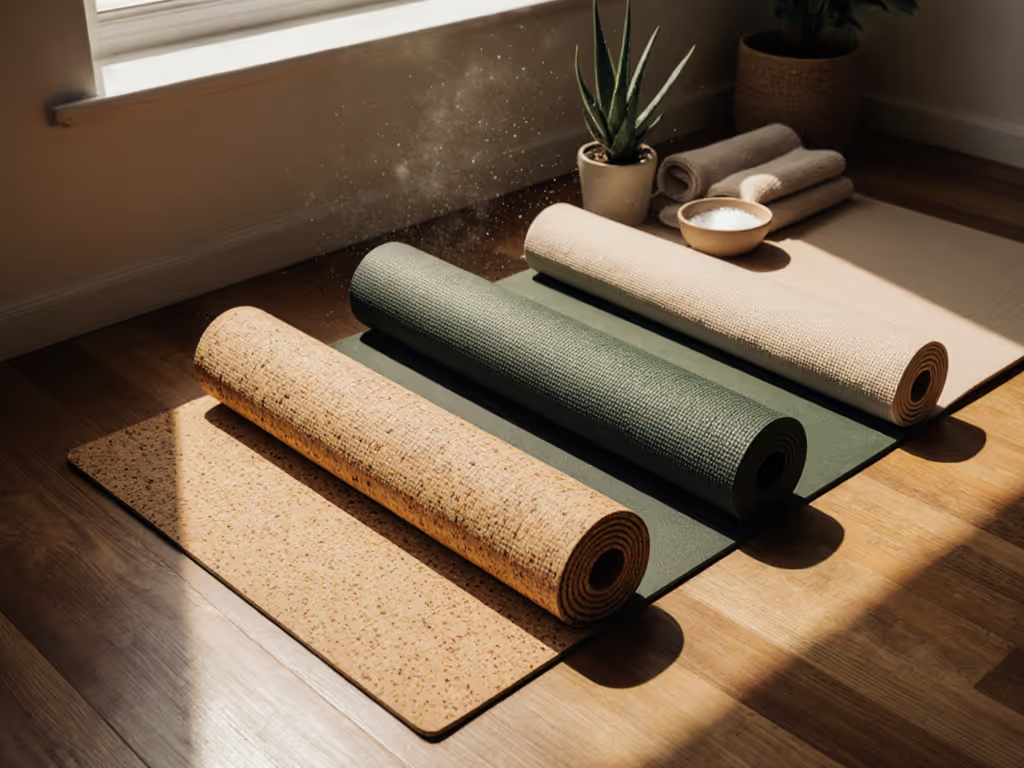
Cork-based mats occupy an interesting middle ground. Cork is naturally anti-microbial and grippy even when damp, but it's inherently less compressible than foam. If you layer cork (typically 3-4 mm) over a 2-3 mm cushioning base, you gain grip without sacrificing stability, a configuration often found in adaptive or therapeutic mats[4]. The trade-off: cork can absorb moisture over time and requires more intentional drying between uses, particularly in humid climates.
How Do Material Choices Affect Grip in Seated Practice?
Grip is the least standardized metric in yoga mat marketing, yet it's critical for wheelchair users. Grip depends on surface texture, material chemistry, and moisture. For a deeper dive into how texture affects friction, read our surface grip explainer.
Natural rubber (often harvested from Hevea brasiliensis trees) creates micro-grip through its inherent tackiness. It grips dry and slightly improves when damp, a property that matters if you're working with any sweat or moisture. The catch: processing can introduce volatile organic compounds (VOCs) and odor, particularly in the first weeks. I've seen classroom scenarios where an eco-marketed natural rubber mat smelled intensely of solvents despite passing safety standards; the grip was excellent, but students couldn't focus. That taught me to separate what a mat is made of from how it's been finished. Ask suppliers for off-gassing profiles and, if possible, order a sample to air out before committing to a large purchase, especially for studios or group settings.
TPE (thermoplastic elastomer) is a synthetic blend engineered to mimic rubber's properties. It's often lower-odor than conventional natural rubber, more durable in humid or hot environments, and hypoallergenic (important if latex sensitivity is a factor). TPE's grip is consistent but less "alive" than natural rubber; it feels stable but doesn't respond as dynamically to hand position changes. For wheelchair users, this consistency is often an advantage, predictable grip reduces the mental load of micro-adjusting your grip throughout a session.
Polyurethane (PU) surfaces, often used as a top layer or complete mat, offer excellent grip when dry but can feel slick when wet. If your practice involves any moisture (perspiration, humidity, or intentional dampening for deeper stretches), PU may disappoint. PU can also off-gas more intensely than TPE or properly finished natural rubber, so ventilation and curing time matter. Performance-wise, PU shines in cool, dry environments.
For wheelchair users, the ideal material trades off as follows:
| Material | Dry Grip | Damp Grip | Odor Profile | Durability | Best For |
|---|---|---|---|---|---|
| Natural Rubber | Excellent | Improves | Can be strong initially | High, if sourced transparently | Committed practitioners who can address VOCs |
| TPE Blend | Good | Stable | Minimal | Very High | Studios, humid climates, latex-sensitive users |
| Cork + TPE Base | Excellent | Excellent | Minimal | High | Long-term seated practice, moisture concerns |
| Polyurethane | Excellent | Slippery | Moderate | Medium | Dry, cool studios; less ideal for damp conditions |
What Role Does Non-Slip Base Traction Play?
Your wheelchair rolling during a transition is a real safety concern. If you practice on wood, tile, or carpet, our floor compatibility guide shows how to pick a base that won’t slide. A non-slip base keeps the mat planted to hardwood, tile, or carpet, crucial when you're shifting weight laterally or practicing arm balances.
Base coatings fall into two categories:
- Closed-cell or rubber-bonded bases create friction through material density and texture; they're common on higher-end mats and perform consistently across floor types. The downside: they can wear smooth over years, and they're harder to clean (debris lodges in the texture).
- Open-pore bases (often TPE or natural rubber) rely on microscopic grip; they perform brilliantly on smooth tile but can slide unpredictably on carpeted surfaces. On carpet, they may also catch fibers, requiring frequent cleanup.
For wheelchair yoga, seek a closed-cell, textured base with a claimed coefficient of friction of 0.7 or higher, a metric rarely advertised but sometimes available from manufacturers upon request. A mat that passes this threshold will resist sliding when you apply 15-20 pounds of lateral force, a realistic range for most seated transitions.
If your flooring is low-pile carpet, add a non-slip rug underlay (typically rubber or felt) beneath the mat. This simple addition transforms an unstable mat into a locked platform and costs under $20.
How Do Accessible Yoga Mat Features (Like Tactile Guides) Affect Performance?
Some mats marketed for adaptive or inclusive yoga include tactile features (raised lines, hand and foot markers, or braille labels) designed to guide body position without vision[1]. For options with printed lines that improve placement, see our alignment mat reviews. These features serve accessibility but introduce design considerations for grip and stability.
Raised tactile elements (typically embossed or molded into the surface) can actually improve stability for wheelchair users if positioned thoughtfully. A raised centerline, for example, can anchor your alignment during seated forward folds, giving proprioceptive feedback that helps you stay centered. Hand and foot stations provide micro-textures that increase grip in those zones.
The trade-off: molded elements can trap sweat, dust, or cleaning residue and create micro-catching points that slow down transitions. If you're practicing dynamic, flowing sequences from a wheelchair, these tactile elements can feel more grounding; if you favor minimal visual clutter or rapid transitions, you might find them unnecessary.
Durability and Lifecycle: Why It Matters for Seated Practice
Wheelchair users often spend extended time on a single mat, 20-30 minutes of seated or low-mobility practice is not unusual. This sustained, localized pressure accelerates wear in ways that standing practice doesn't. Standard yoga mats degrade within 18-24 months under this loading; quality adaptive mats can last 3-5 years.
Look for mats with closed-cell construction (resists water absorption and mold) and multi-layer bonding (top surface won't peel from the base). Compression testing is a good indicator: a mat that loses more than 5% of thickness after 100,000 cycles of applied pressure is prone to premature flattening. Few manufacturers publish this data, but it's worth asking.
Sustainability with receipts means choosing a mat durable enough that you're not replacing it annually. A $120 mat that lasts four years is more sustainable (and cheaper per use) than a $40 mat replaced four times. To quantify this, use our cost-per-use analysis to compare long-term value across brands. Natural rubber and TPE blends tend to outlast PU for seated practice; cork-topped mats offer longevity if you can manage the moisture profile.
What Should You Know About Odor and Off-Gassing?
VOCs (volatile organic compounds) and odor are legitimate concerns, particularly in shared or clinical settings. A new mat might off-gas for days or weeks, and that smell can trigger discomfort or concern, even if the actual toxicity is within safe ranges.
For wheelchair yoga spaces, request odor profiles from manufacturers. TPE-based mats typically off-gas for 24-48 hours; natural rubber can persist for a week or more. Cork mats smell naturally earthy but produce minimal chemical off-gassing. If you're setting up a studio or clinic environment, plan to air-cure mats before use, lay them flat in a well-ventilated space, preferably outdoors, for 3-7 days. This simple step eliminates much of the perceptible odor and allows remaining VOCs to evaporate before students or patients arrive.
How Do You Match Mats to Your Specific Wheelchair and Practice Style?
Your wheelchair dimensions and your practice intensity should guide your choice. If you use a manual chair and practice flowing sequences (e.g., chair vinyasa), prioritize a lighter mat (under 4 lbs) that won't be cumbersome to roll up and transport. Power wheelchair users might accept a heavier, denser mat since portability is less critical.
For restorative or gentle practice (yin, supported stretches, breathwork), a thicker, more cushioned mat (5.5-6 mm) with medium density supports longer holds. For dynamic or power-based sequences, a firmer mat (closer to 4-5 mm, higher density) provides the stability and responsiveness your movements demand.
Climate matters too. In humid or hot environments, TPE or cork blends are superior; in cool or dry settings, natural rubber performs beautifully (assuming VOCs are managed). If you practice in multiple environments (home and studio), consider maintaining two mats or choosing a versatile option that performs adequately across conditions rather than optimally in one.
Key Takeaways: What to Prioritize
- Stability is non-negotiable: Seek mats with closed-cell bases, 5-6 mm thickness, and 100-120 kg/m3 density for wheelchair yoga.
- Material choice reflects your environment: Natural rubber excels in cool settings; TPE dominates in humid studios; cork blends offer excellent grip across conditions.
- Grip testing isn't just marketing: Ask suppliers for friction coefficients, request samples, and test on your actual flooring before committing.
- Cushioning and stability require balance: Reject the myth that "more padding is better"; too-thick mats destabilize seated practice.
- VOC profiles matter in shared spaces: Budget time for air-curing, especially if you're outfitting a facility.
- Durability is sustainability: Invest in a mat that will serve you faithfully for years, not one you'll replace seasonally.
Further Exploration
The mat landscape is shifting. Studios and facilities are increasingly adopting tactile and adaptive designs, not just for wheelchair users, but for anyone seeking guidance and grounding. If you're building a personal practice or curating a studio, consider ordering samples from at least two material profiles (e.g., TPE vs. cork blend) and testing them over a week in your actual space. Texture, odor, base grip, and feel are intensely personal; no review can substitute for your own body's feedback.
Connect with adaptive yoga instructors in your community or online forums dedicated to accessible movement; they often share real-world durability and performance insights that cut through marketing noise. And if you're sourcing for a clinic, studio, or accessibility program, request bulk trial options or extended return windows so you can validate your choice before a large purchase.
Your practice deserves a mat that meets you where you are, grips where it matters, and stays grounded under you. That's not a luxury, it's the foundation for confident, joyful movement.
Related Articles