

Yoga Mat EMF Protection: Material Trade-Offs
By Sofia Álvarez • 7th Mar
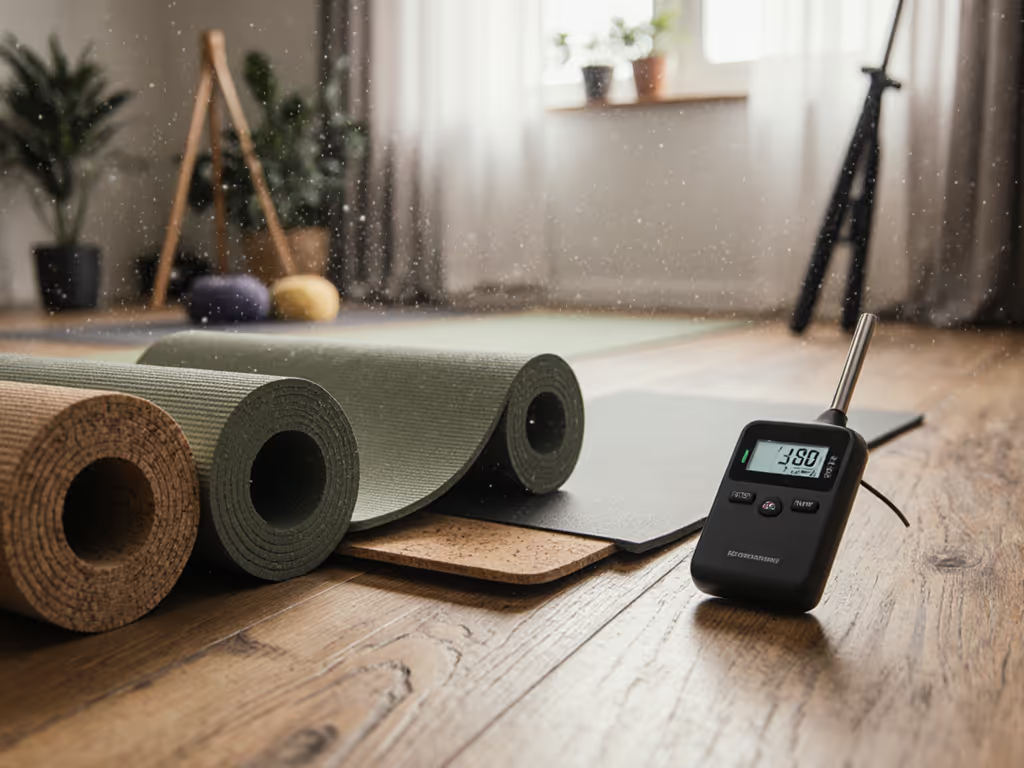
The claim sounds compelling: a yoga mat EMF protection layer that shields you from electromagnetic fields while you practice. But like many wellness products, the marketing often outpaces the physics. As someone who's spent years untangling materials chemistry from marketing narrative, I've learned that EMF shielding mats present a genuine case study in the gap between what products claim to do and what they actually deliver under real conditions. Understanding that gap (and the material trade-offs involved) is essential before deciding if an EMF shielding yoga mat is right for your practice.
What Is an EMF Protection Yoga Mat, and How Is It Actually Supposed to Work?
EMF protection mats use conductive layers (typically silver-coated nylon, carbon-infused polymer, or stainless-steel mesh) sandwiched between traditional cushioning materials. The theory is straightforward: conductive materials conduct electrical charge away from your body, reducing your exposure to electromagnetic fields in your immediate environment.
Most require a grounding cord that plugs into a standard outlet to complete the electrical path to earth. Without grounding, conductivity alone won't dissipate charge effectively. This is a critical detail often buried in marketing copy.
The mechanism differs depending on what the mat claims to protect you from. Static charge buildup (that shocking sensation you feel after practicing on synthetic mats in a dry room) is one phenomenon. Low-frequency electromagnetic fields (ELF) from power lines and Wi-Fi are another. And radiofrequency (RF) radiation from cell towers or wireless devices is yet another. Each requires different material properties, and no single mat mechanism addresses all three equally. If you need a refresher on base mat materials, our PVC vs natural rubber guide explains grip, durability, and eco trade-offs.
Do These Mats Actually Protect You From Radiation or Electromagnetic Sensitivity?
This is where clarity becomes essential. Testing published by materials engineers confirms a hard truth: EMF-shielded yoga mats do not meaningfully protect you from ambient Wi-Fi, cell tower, or power-line radiation in real-world use. Here's why.
Lab measurements under ideal, static conditions show attenuation (reduction) of around 18-22 decibels for radiofrequency signals. That sounds technical, but the practical result matters more: you need at least 30 dB attenuation (representing 99.9% reduction) to block RF effectively. Most commercial yoga mats fall well short. During actual movement (which is what yoga involves), the mat shifts, gaps form between your body and the surface, and your own tissues absorb or reflect most ambient RF energy anyway.
Regulatory agencies like the FCC and ICNIRP confirm that typical environmental RF exposure is orders of magnitude below safety thresholds. The risk you'd be mitigating is already minimal under normal exposure. Marketing often implies an urgent health threat where measured science does not support one.
I encountered this disconnect firsthand years ago at a community studio when a student unrolled an "eco-friendly" mat touted as low-EMF. Within minutes, the solvent smell forced us to pause class and air the room. I brought samples home and ran them through the lab. The grip was genuinely excellent, and the emissions profile was well within acceptable limits, yet the marketing had framed the mat as a health necessity while failing to disclose its own chemical profile. That taught me: material names matter less than verified formulations and context.
Can These Mats Reduce Static Buildup During Hot Yoga?
Yes, but only under specific, testable conditions. Static dissipation is a real, measurable physical phenomenon, unlike the more speculative EMF claims.
Conductive yoga mats can reduce voltage accumulation if three criteria are met: the mat has low electrical resistance (ideally 10^4-10^9 ohms per square), the conductive layer is continuous without gaps or delamination, and the mat sits on a conductive floor (concrete, tile) with proper grounding. Testing of budget-friendly mats under $85 showed that only 3 out of 7 met this resistance threshold, and all required concrete flooring to function.
On carpet or high-pile flooring, even a well-designed conductive mat loses its grounding path. For surface-by-surface advice, see our floor compatibility guide. The result: static still builds up. This detail is rarely mentioned in product descriptions.
One practical lever exists: humidity. Raising ambient humidity by just 10% cuts static buildup by approximately 40%. A small humidifier in a dry practice space often outperforms a conductive mat at a fraction of the cost.
What Material Trade-Offs Come With EMF-Shielding Design?
Building conductivity into a yoga mat means embedding metal fibers or mesh into rubber, cork, TPE (thermoplastic elastomer), or polyurethane (PU) layers. Each combination carries performance trade-offs.
Natural rubber + conductive fiber: Natural rubber has inherent ionic content and moisture absorption, which supports static dissipation. However, adding metallic fibers can increase odor during manufacturing and create a stiffer feel underfoot. Durability of the conductive layer depends on how well it's bonded to the rubber; delamination after 6-12 months of use is common in lower-cost products.
TPE (thermoplastic elastomer) + conductive layer: TPE is typically an insulator; it traps electrons rather than dissipating them. Adding a conductive layer on top creates a false sense of protection if that layer isn't continuous or if the TPE base blocks the conductive path. Many budget mats use this strategy (embedding conductive fibers in an insulating substrate) and market it as shielding without verifying actual surface resistivity.
PU (polyurethane) + conductive coating: PU is durable and provides good cushioning, but it's also an insulator. Conductive coatings on PU can work if the coating is thick and uniform, but PU's density and moisture resistance mean the mat won't passively dissipate charge like cork or natural rubber would.
Cork + conductive mesh: Cork is naturally conductive due to its cellular structure and moisture absorption. Adding a metallic mesh layer can enhance shielding, but cork's lower density means less grip and cushioning overall. The trade-off is a thinner, firmer mat.
None of these combinations eliminates the fundamental trade-off: adding conductivity often means sacrificing cushioning, reducing flexibility, or increasing weight. A mat designed primarily for static dissipation may feel less forgiving on wrists and knees.
Are These Mats Safe to Use Daily?
Yes, provided the mats are constructed from non-toxic, non-volatile materials. Conductive fibers (silver, copper, carbon) are inert when embedded in a stable polymer or rubber matrix.
The real safety concern is off-gassing and VOCs (volatile organic compounds). Lower-cost EMF mats often use adhesives and synthetic polymer binders to hold conductive layers in place, and these can emit noticeable odors or off-gas over weeks or months. If you're sensitive to chemical smell or have respiratory sensitivities, this matters more than the EMF shielding itself. Asking a vendor for material safety data sheets (MSDS) and testing reports (not marketing copy) gives you actual clarity.
Mats marketed as "eco-friendly" or "low-odor" should come with third-party certifications (like Oeko-Tex or Global Organic Textile Standard) verifying VOC limits. Without these, "low-odor" is a subjective claim. Sustainability with receipts means verifiable specs, not just reassuring language.
How Do I Choose an EMF-Shielding Mat for My Practice?
Start by asking: What problem am I actually trying to solve?
If your concern is static shock during hot yoga in a dry climate, a conductive mat on concrete flooring can genuinely help. If your concern is ambient Wi-Fi or cell-tower radiation, the science is clear: a yoga mat won't meaningfully shield you, and your money is better spent on practices with proven health returns (sleep quality, stress management, consistent movement).
If you choose a mat with conductive properties, verify:
- Surface resistivity (measured in ohms per square) is published and under 10^9. This is the only meaningful specification for static dissipation.
- Material composition includes low-VOC, non-toxic polymers or natural rubber, with a third-party emissions test.
- Grounding setup is clearly documented: Do you need an adapter? Which outlets work? Does your flooring support it?
- Durability testing under real conditions: How long does the conductive layer stay bonded? Are there published wear-test results?
- Grip and cushioning meet your practice needs. Even a perfectly grounded mat fails if you slip during downward dog or your knees ache after class.
Performance context matters more than marketing claims. A mat might reduce static perfectly while offering mediocre grip, or vice versa. Know your trade-off, not just the label.
What About Natural Material EMF Protection?
Natural material EMF protection is a misleading phrase, natural materials don't inherently protect you from ambient EMF radiation any better than synthetics. However, natural rubber and cork do naturally dissipate static charge due to their ionic content and moisture absorption, which is a tangible benefit under the right conditions.
Cork mats offer moderate conductivity without requiring conductive fibers, but they're firmer, less cushioned, and require a sealed top layer for durability. Natural rubber offers better grip and comfort but can off-gas if sourced from lower-grade suppliers or bonded with strong adhesives.
If your priority is low-EMF yoga practice, the most evidence-backed move is choosing a mat made from consistently sourced, low-VOC natural or recycled materials (not because it shields you from radiation, but because it minimizes the chemical exposure in your immediate space and reduces the embodied carbon and toxicity in production). For a deeper look at lifecycle impact, read our yoga mat carbon footprint analysis. That's sustainability with receipts.
Further Exploration
If EMF shielding is on your radar, dig deeper into the actual specifications of any mat you're considering: request surface resistivity data, off-gassing test results, and grounding guidelines. Ask vendors for peer-reviewed studies (not white papers) behind their claims. And honestly assess your practice environment: Is humidity low? Is your flooring conductive? Is static actually disrupting your practice, or is it a minor discomfort? The mat that serves you best is the one that performs under your specific conditions with materials you can verify. Start there.
Related Articles